
Classification of soils and rocks using high-pressure cylindrical expansion tests
J.P. BAUD - Eurogéo, Avrainville, France
M. GAMBIN - Apageo, Magny les Hameaux, France
Summary
The physical and mechanical properties used to characterise soils and rocks are different depending on the approach and objectives, those of geotechnics, engineering geology or rock mechanics. The authors suggest that the measurements made during the expansion of the cylindrical cavity of a borehole, which can be reduced to the two fundamental parameters, a pressure modulus and a limit pressure, should be used for a seamless classification from soils to rocks, based on the Pressiorama® diagram developed for soils some years ago.
Introduction, is the boundary between soil and rock useful?
Defining a boundary between soil and rock is an approach that seems natural to every human being, from the Neolithic farmer to the 21st century builder, and yet it remains an approach that is, if not subjective, then at least contingent, depending on the perception of the use of the natural material on which he or she evolves and with which he or she is measured. For the geologist, since the emergence of this discipline, all the constituents of the earth's crust are rocks, from water to the matter of the continental bases, independently of their state, solid or liquid or even gas. All these rocks have particular histories and futures, more or less essential to the world's development, more or less sustainable, like petroleum, the "oil of stone". For any builder, this global classification is incongruous, and rock is distinguished by its solid character from soils, which are all soils that are not rocks, and characterised by their more or less marked lack of solidity: weatherable, terrassable, friable, compressible, soft to the limit of liquidity. Historically, the definition of Terzaghi [1], with his dual background as a geologist and engineer, establishes the mechanical limit between soil and rock: "Soil is a natural aggregate of mineral grains that can be separated by slight mechanical actions such as agitation in water. Rock, on the other hand, is a natural aggregate of mineral grains bound by strong and permanent cohesive forces. As these terms 'strong' and 'permanent' are subject to various interpretations, the distinction between soil and rock is necessarily arbitrary. In fact, there are many natural aggregates of mineral grains that are difficult to classify as either soils or rocks" [1]. Figure 1: Cycle of mineral (and organic) matter from rocks to soils. One of the aims of the Athens 2011 symposium is to focus on terrains whose scope is claimed by both soil mechanics and rock mechanics. And although specialists in both disciplines are usually in a cordial and fruitful relationship, and develop their expertise within the framework of universal physical laws, the claim sometimes goes so far as to challenge the relevance of the other's approach: "Strong cohesion and developed fissuring, two criteria often cited for rocks, remain insufficient. The separation between soils and rocks depends very much on the school of thought and the engineer's field of experience; the congresses that have tried to group stiff soils and soft rocks together have only added to the confusion. It is for geology to facilitate a clarification. [2]. The following diagram (Figure 1) is therefore based on the distinction made by classical geology, prior to plate tectonics, between the factors of crustal rock formation, or internal geodynamics, and the factors of rock degradation and recomposition of sedimentary rocks, or external geodynamics.
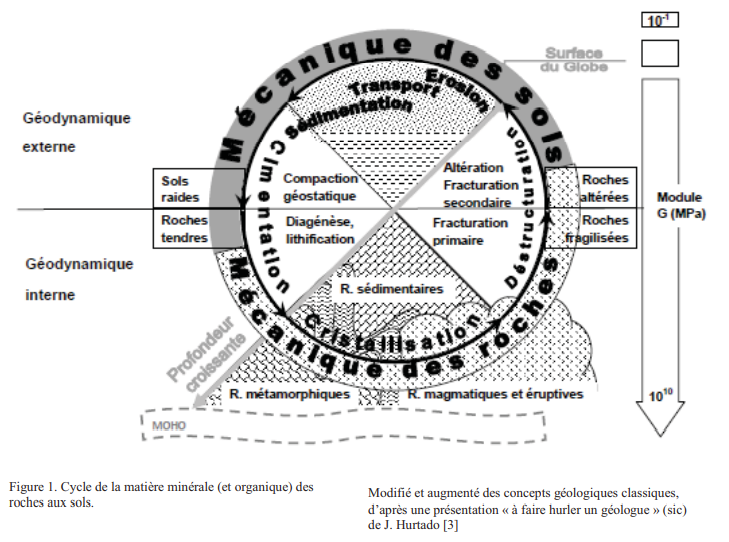
This is, to a first approximation, what forms the boundary between the fields of rock mechanics and soil mechanics. The geologically very long cycle of a mineral particle, for example a magmatic silica grain within a granite, becoming a beach sand grain before returning to the base of the earth's crust, leads it to be a component of rocks and soils of extreme mechanical resistance, symbolised in the margin of the diagram by the shear modulus of these formations. The essential genetic characteristic of rocks is the increasingly strong bonding between the grains that make them up, by cementing during the diagenesis of sedimentary rocks, crystallisation or recrystallisation of metamorphic and magmatic rocks. What happens at the Earth's surface is the destruction of these strong structures, which progressively lead to the juxtaposition of grains with no bonds. To compare the mechanical characteristics of a very stiff soil and a fairly weathered rock, even if they seem almost identical, must be done keeping in perspective the fact that they are at the antipodes of this cycle.
Characterisation of soils and rocks by classical pressuremeter parameters
The behaviour law of any material subjected to the expansion of a cylindrical cavity can be essentially reduced to a fairly simple hyperbolic rule [4]. In soils, the two fundamental parameters EM and p*LM (pressure modulus and limiting pressure) which are derived from this allow a classification of soils, due to the close relationship between the EM/p*LM ratio, and the type of soil behaviour, between the extreme sandy and clayey poles, depending on the proportion and granulometry of the soil components. This classification is illustrated, for example, in the Pressiorama® diagram [5], and is totally linked to the structure coefficient defined by Ménard as the EM/E ratio, where E is an acceptable "Young's modulus" [6] [7]. The future of this classification, and the relevance of the soil structure coefficient, is a question that arises when the pressuremeter test is applied to increasingly stiff "soils", which may be either sedimentary soils in a high state of geostatic consolidation, or rocks in a more or less advanced state of alteration and decompression, or less altered, fractured or poorly fractured rocks, and finally to massive rocks.
Pressuremeter behaviour of unstable soils, soft rocks and solid rocks
The hyperbolic behaviour law of soils subjected to a radial loading test is the overall measure of wall deformation under the shear stress experienced by the soil. The rearrangement of grains during deformation and the generalisation of failure to a soil zone is a phenomenon whose principle is well established and understandable [6] [7], even if the details of its occurrence and its modalities according to the soils will still be the subject of geomechanical research for a long time. During the gradual transition to increasingly indurated soils, weathered rocks and fractured rocks, the radial expansion behaviour of the soils does not change abruptly, but the scale of the associated stresses changes progressively by one or two powers of 10 compared to "loose" soils, and the limitation of the tests to 5 MPa due to the available equipment only allows access to the initial phase of the deformations. The test then only involves the measurement of a modulus over this limited range of stresses, without knowledge of the limit pressure of the evolution of the modulus under higher stresses. With the development of pressuremeter equipment making it possible to reach test pressures of 25 MPa [8], it is possible to begin to see whether the mode of failure of materials located in the common pressure range between soils and rocks remains comparable to that of soils.
Shear and fracture mode of indurated soils and rocks
The increase in the EM/p*LM ratio with p*LM is a common observation. On the pressuremeter curve this corresponds to an increase in the radius of curvature of the plots, and a tendency for the structural coefficient of highly indurated soils to approach 1; in other words, in non-fractured solid rocks it is usual to think that the expansion test directly measures a Young's modulus: - the cementing between their mineral components limits a rearrangement of these minerals under high shear stresses; - the density, continuity, openness and surface condition of the epents, and the infilling of this fracturing influence the deformation of the wall of a radially expanding borehole.
Pressuremeter behaviour of altered or fractured rocks
The fracturing of the rocks is clearly shown on the pressuremeter curve by the presence of a very long phase of decrease in the slope of the curve when the pressure is increased, which corresponds to the progressive closure of the cracks close to the borehole, and then the inclusion by the test of cracks that are increasingly distant from the borehole. Whatever the final pressure reached, between 5 and 25 MPa, we find, as for the standard pressuremeter tests, three types of test curves at the time of their interruption: those which are still in the phase of crack closures and decrease of the DV/DP slope, those for which an inflection point has been passed with growth of DV/DP without creep, and finally those for which appears at the end of the test an onset of creep and greater deformations.
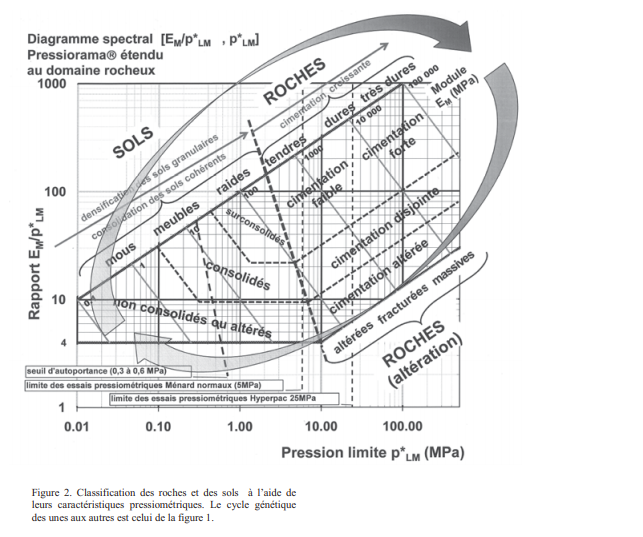
These 3 types of curves allow a basic classification:
- massive rocks with varying degrees of fracturing;
- Fractured and weathered rocks, but with a low compressibility of the rock matrix;
- weathered and decomposed rocks evolving into soil-like behaviour.
Transition from hard soil to soft rock and from weathered rock to soil: gradual or abrupt?
Use of the spectral diagram [EM/p*LM , p*LM] to visualise the soil-rock transition
As a framework for reflection, we propose extending the spectral diagram [EM/p*LM , p*LM] or Pressiorama® , which we usually use in pressuremeter reconnaissance campaigns [5], to the field of test pressures above 10 MPa, on the one hand to detect anomalies in the performance of the tests or in the soil itself, and above all to classify the soils encountered. The real cases of highly indurated soils and altered rocks that we can position in this extension of the diagram to the rocky domain are quite numerous up to extrapolated limit pressures of 15 to 18 MPa. Beyond that, the first Hyperpac tests [8] give us points at 25 MPa and allow us to envisage possible extrapolations of limit pressures up to 30 to 40 MPa, if at least the pF-pLM correlation of the soils remains validated. Beyond that, dilatometer tests reinterpreted according to the pressuremeter method can give EM moduli higher than 105 MPa, but in this type of test we are very far from estimating the limit pressure [9].
Brittle or ductile failure in in situ expansion tests
The previous examples show that, when the pressuremeter test can be pushed far enough, sufficiently soft steep or rocky soils show a behaviour that is not very different from soils, with a creep phase and large deformations. The notable difference is the tendency for the EM/p*LM ratio to increase with the limit pressure, rapidly exceeding the usual values for loose soils, reaching 50 or 100, and even 200. The pressure curves corresponding to such high values of EM/p*LM show an increasingly clear "fold" between the two phases, before and after creep.
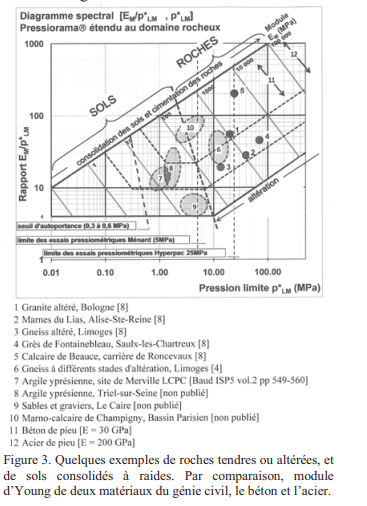
As investigations progress towards solid rock, it seems to appear that the behaviour of the material is approaching the "fragile" type in which failure would occur practically without premise at the end of a quasi-elastic range. This intuition is generally shared, for example by the fear expressed against tests at 25 MPa in concrete (case of piles or columns), and Ménard himself envisaged "bursting" the rock [10]. For the time being, even in meJ.P. Baud and M. Gambin / Classification des sols et des roches à partir d'essais d'expansion cylindrique 329 sures à 25 MPa, this type of behaviour has not been observed, and all the materials tested show progressive creep announcing the beginning of a failure phase. At higher pressures, rock failure by expansion in drilling can be obtained industrially by injection of expanding foam under pressure (such as the DMX process of Colas-Rail). In this type of tearing of rocky zones close to the surface of a working face, with rapid pressurisation under about 50 to 60 MPa, two distinct modes of rock failure can be observed: the most frequent is the immediate decomposition into polyhedral blocks cut by the opening of pre-existing closed fractures; more rarely, in less fissured rocks, the expansion causes a displacement of the wall for a few seconds, before a crumbling of the rock mass into elements whose faces are not all flat and seem to correspond to the opening of intergranular joints (Delaporte, oral communication, [11]). The state of knowledge on the failure of non-fractured rock samples under triaxial stress and on the sliding resistance of rock joints is summarised by Parriaux [12] and detailed in an extensive bibliography by Al Bied [13]. Matrix failure occurs by the appearance of shear bands in areas of stress concentration. During an expansion test under very high pressure, the confinement provided by the surrounding rock mass should therefore lead to a rupture combining both the activation of the slippage according to the pre-existing joints, and the formation of shear bands near the wall, making it possible to keep the notion of pressurised creep pressure in the rocks.
Provisional conclusion and future developments
The recent development of borehole expansion test equipment at 25 MPa still needs to be measured in a variety of field conditions so that feedback can support the hypotheses made here on shear fracture of rocks. It is envisaged that the test pressures will be increased to around 50 MPa in the near future. The diagram of continuous classification of soils and rocks by pressure values serves as a framework for this work, as well as the parallel development of isovalues of the rheological coefficient compatible with the practice of Menard pressuremeter methods [7].